I was inspired to pick up where Alexe left off with her “est” blogs, and write about “Farthest,” because of some recent, cool, astronomical news.
There was recently excitement over a Hubble Space Telescope discovery of seven primitive galaxies located over 13 billion light years away from us. The results are from survey of the same patch of sky known as the Ultra Deep Field (UDF). This survey, called UDF12, used Hubble’s Wide Field Camera 3 to peer deeper into space in near-infrared light than any previous Hubble observation.
Why infrared? Because the Universe is expanding; therefore the farther back we look, the faster objects are moving away from us, which shifts their light towards the red. (The opposite of the our namesake effect, blueshift!) Redshift means that light that is emitted as ultraviolet or visible light is shifted more and more to redder wavelengths. Spectral features from galaxies that we normally see in UV or visible are likewise shifted into infrared, particularly for the most distant things. Without infrared light we might not see those features, and thus couldn’t determine the distance to these far away objects.
The extreme distance of these newly discovered galaxies means their light has been traveling to us for more than 13 billion years, from a time when the Universe was less than 4% of its current age. (Current observations suggest that the Universe is about 13.7 billion years old.)
Their discovery, which you can read more about in the NASA feature is exciting because it might give us an idea of how abundant galaxies were close to the era when astronomers think galaxies first started forming. (Phil Plait has a good column about this discovery too.)

Credit: NASA, ESA, R. Ellis (Caltech), and the UDF 2012 Team
With every year that passes, our newest technology enables us to see further and further back. The microwave afterglow of the Big Bang that was seen by the COBE and WMAP satellites is from about 378,000 years after the Big Bang. That’s a long time ago to be sure, but it was also before the first objects in the universe formed.
The questions are, how far back can we see at visible and infrared wavelengths? And what can we see?
Read more »
Welcome back to the -EST blog! This is where I chat about some of the astronomical superlatives that go the extra distance to make our universe so interesting and awesome. In this post I’m going to talk about a pretty popular topic, the darkest things in our universe – black holes. A lot of people think of black holes like giant outer space vacuum cleaners. While they do end up “sucking in” anything that gets too close, this isn’t the most correct way to think about them. Black holes are pretty seriously complex, but I am going to step back to some basics and try to build a decent picture.

Credit: Ute Kraus, Institute of Physics, Universität Hildesheim, Space Time Travel
Black holes are the darkest things in our universe because they emit no light whatsoever in any wavelength. The reason there are no images of black holes themselves is because it is a fact of their physics that they cannot be seen (The image above is an artists conception). Any light that gets too close falls in and can’t get back – this makes black holes problematic because that is how we see things, we see the light that comes back to our eyes. So if black holes produce no light and no light that falls in can ever get back out they can never be seen. But we can still study them and deduce how we think they work. Let’s take a few steps back to try and get our bigger picture.
Read more »

Numerical simulation of two merging black holes performed by the Albert Einstein Institute in Germany: what this rendition shows through colors is the degree of perturbation of the spacetime fabric, the so-called gravitational waves. Credit: Werner Benger
Who cares about gravity? Shouldn’t this be a settled question by now? This is actually one of the reasons why I wanted to become a theoretical physicist: I longed for knowing more about this apparently obvious but deeply mysterious force of Nature. I’ve always shared the mindset of the great Einstein: “I want to know God’s thoughts, the rest are details.”
Here I am then, mingling with some of the smartest minds in the world, theoretical physicists at NASA and the University of Maryland to study gravitational waves, a new type of astronomy. I got here a year ago, soon after earning my doctorate at the University of Geneva. That’s right, Geneva: the place where the end of the world might be provoked by that crazy underground machine, the one that is after the Higgs boson and could produce mini black holes (don’t worry: this is a remote and harmless possibility). I am very happy I could visit the facility and its particle accelerator, which is called the Large Hadron Collider, or LHC, and is the flagship of CERN, the European Center for Nuclear Research. Even though this very sophisticated, huge and unique apparatus has been built to know something new about the invisible world of subatomic particles, there is hope that the discoveries made will shed some light on the mysteries of gravity, too.
Read more »
A good chunk of the exoplanets that we’ve detected so far are huge, Jupiter-sized and larger. A lot of them are orbiting their stars at very short distances – it might seem strange to think that planets bigger than Jupiter are orbiting their stars closer than Mercury orbits the Sun, to the point where some of them take days or only fractions of a twenty-four hour day to complete one full orbit, but that’s what we’ve actually observed (among other really cool kinds of exoplanets). For comparison, Jupiter takes about twelve Earth years to travel around the Sun once, and these giant Jupiter exoplanets orbit in only fractions of that time. Exoplanets like these are called hot Jupiters, so named of course because while they’re “jovian” (Jupiter-like) in size, their proximity to their parent stars means that their surface temperatures are several hundred times as high as those of our outer planets. Hot Jupiters don’t start out at their sweltering homes though, and how they get there is pretty interesting.
In protoplanetary and debris disks (the millions of miles of stuff around a young star, yet to conglomerate into bigger objects like planets and asteroids), material is concentrated in rings. To maintain that ring structure (rather than have the material swirl out into thinner and thinner strands until an even distribution of matter is achieved), the rings can’t be shaped in perfectly concentric circles. Rather, each ring is tilted just a little to one side with respect to the one inside it, creating a twisting effect that causes some sections along each ring to be bunched up closer together, and some sections to be spaced out farther apart. This causes the matter in these bunched-up areas to be packed more densely than the places spread farther out. Just like how it’s easier to fit ten people into a van than it is into a sportscar, the amount of stuff there is doesn’t change – just how it’s being packaged. It helps to take a look at the diagram to picture this, since there you can really see how the subtle tilts in each ring contribute to the swirling effect.

A diagram of the structure of spiral density waves, credit Dbenbenn and Mysid; distributed via Creative Commons License
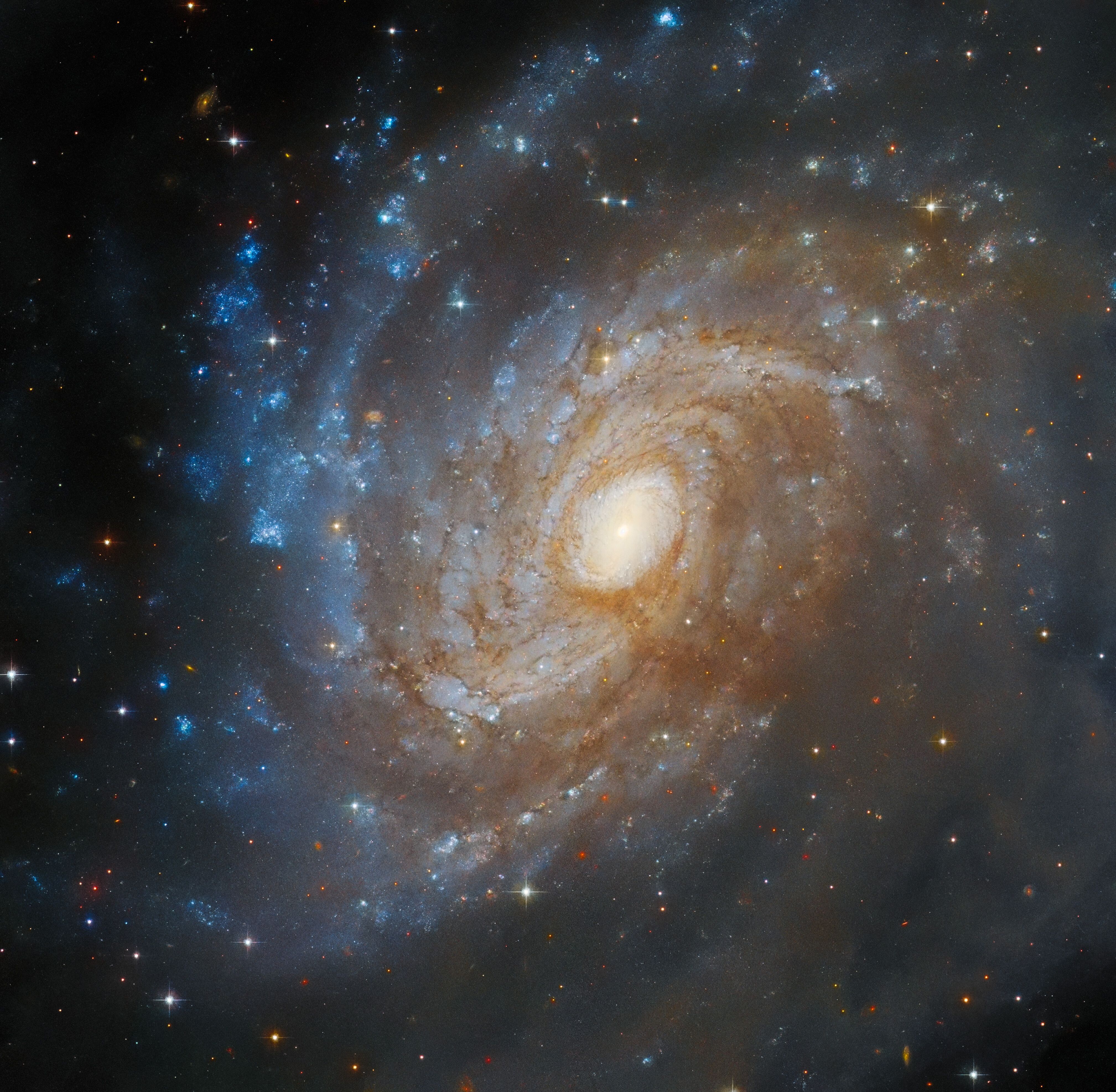
This, incidentally, is also what gives spiral galaxies their shape – on a much bigger scale, of course!
Read more »