Posts tagged: stars

[Sara's blog] Awww! Cosmic baby pictures!

Infant Stars Peek Out from Dusty Cradles
Protostars in Messier 78, as seen by multiple observatories
Credit: NASA/ESA/ESO/JPL-Caltech/Max-Planck

The side-by-side images above depict protostars found in Messier 78, a reflection nebula found within the constellation Orion (but not the Orion Nebula, which is Messier 42). These are some of the youngest stars that astronomers have ever seen – some of them are still embedded deeply in a gaseous envelope, which would suggest that they’re under 25,000 years old. That may seem like a long time compared to our human lives… but for stars that can live for millions or billions of years, it’s still stellar infancy. These images accompanied this press release from the Herschel space observatory, and represent observations from Herschel as well as ground-based telescopes. Though they can be difficult to detect, researchers are hoping to document more young stars in various stages of life – from before birth through infancy – to learn more about the early development of stars.

NASA often looks at “young” astronomical objects, to learn more about the formation and evolution of the Universe. Here’s a selection of some beautiful and interesting cosmic baby pictures…
Read more »

[Try It At Home] Life Cycle of a Massive Star Activity

Stars and planets form in the dark, inside vast, cold clouds of gas and dust. The James Webb Space Telescope’s large mirror and infrared sensitivity will let astronomers peer inside dusty knots where the youngest stars and planets are forming.

The Webb telescope project has developed a bookmark and an activity that you can try at home, with an after school club, or in the classroom to learn more about the life cycles of stars – from birth in a dusty nebula, through developmental changes, death, and then rebirth.

This informal education activity, where colored pony beads are strung on the bookmark, each representing a phase of the star’s life, can be used with kids ranging from late elementary school to middle school. The activity might be young for high schoolers, but you could go more in depth with the science for this age group.

Download the bookmark (pdf) and the activity (pdf).


Life Cycle of a Massive Star

[Jillian's blog] Exoplanets, Tech, and Space Travel

Hubble Directly Observes a Planet Orbiting Another Star
Fomalhaut + Fomalhaut b; courtesy of NASA, ESA, UC Berkeley, NASA GSFC, Lawrence Livermore National Laboratory, and NASA JPL-Caltech)

For a lot of people, exoplanets are some of the most exciting discoveries in current astronomy. The first exoplanets were detected in 1992 orbiting the pulsar PSR B1257+12, all three of which were confirmed in 2007. In 1995, 51 Pegasi became the first main sequence star to have an exoplanet detected around it. In the years since, interest in exoplanets increased as they became easier to discover and there are now seventy-four NASA-confirmed planets outside our solar system, and thousands more are under close watch to see if they’ll make the cut. But long before we knew for sure they were there, even centuries before the excitement within the field today, astronomers wondered if there were any “other earths” out there – and a lot of them were confident that there were! As it turns out they were right, but a lot of what people hear about exoplanets (or exosolar planets, or extrasolar planets, pick your flavor) doesn’t come from scientific sources, which can breed some interesting discrepancies between science-fiction and science-reality. Read more »

[Blog] Awesomeness Round-Up – 5/8/2012

We posted once about NuSTAR, a new X-ray telescope. It was due to be launched in March, but that launch date is now scheduled for June. Below is a great new image of NuSTAR in the nose cone of the Pegasus rocket it will be launched on.


Wrapping NuSTAR in Its Rocket Nose Cone
Credit: NASA


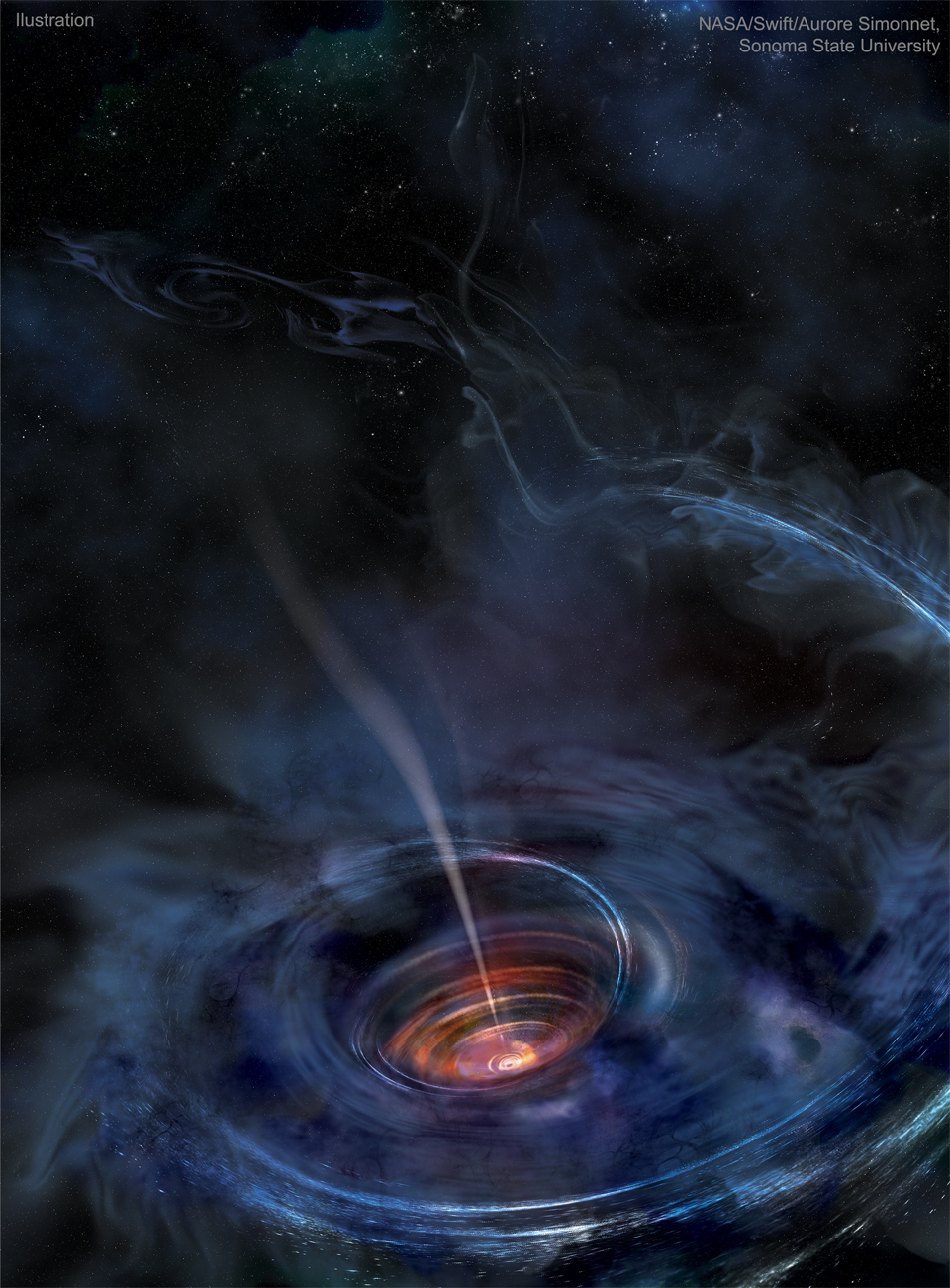
Using NASA’s Galaxy Evolution Explorer, a space-based observatory, and the Pan-STARRS1 telescope on the summit of Haleakala in Hawaii, astronomers have gathered the most direct evidence yet of a supermassive black hole shredding a star that wandered too close.

Simulation of Black Hole Flare
Credit: NASA, S. Gezari (The Johns Hopkins University), and J. Guillochon (University of California, Santa Cruz)

“When the star is ripped apart by the gravitational forces of the black hole, some part of the star’s remains falls into the black hole while the rest is ejected at high speeds,” said project lead Suvi Gezari of the Johns Hopkins University. “We are seeing the glow from the stellar gas falling into the black hole over time. We’re also witnessing the spectral signature of the ejected gas, which we find to be mostly helium. It is like we are gathering evidence from a crime scene. Because there is very little hydrogen and mostly helium in the gas, we detect from the carnage that the slaughtered star had to have been the helium-rich core of a stripped star.”

The above image and this video are computer simulations:

The video shows a star being shredded by the gravity of a massive black hole. As the video caption says, “Some of the stellar debris falls into the black hole and some of it is ejected into space at high speeds. The areas in white are regions of highest density, with progressively redder colors corresponding to lower-density regions. The blue dot pinpoints the black hole’s location. The elapsed time corresponds to the amount of time it takes for a Sun-like star to be ripped apart by a black hole a million times more massive than the Sun.”

Read more »

[Blog] Awesomeness Round-Up – 4/20/2012

Hubble's Panoramic View of a Turbulent Star-Making Region
Credit: NASA, ESA, D. Lennon and E. Sabbi (ESA/STScI), J. Anderson, S. E. de Mink, R. van der Marel, T. Sohn, and N. Walborn (STScI), N. Bastian (Excellence Cluster, Munich), L. Bedin (INAF, Padua), E. Bressert (ESO), P. Crowther (University of Sheffield), A. de Koter (University of Amsterdam), C. Evans (UKATC/STFC, Edinburgh), A. Herrero (IAC, Tenerife), N. Langer (AifA, Bonn), I. Platais (JHU), and H. Sana (University of Amsterdam)

Star-forming region 30 Doradus is colloquially known as the Tarantula Nebula (creepy!), but this new image released with data from Hubble’s Wide Field Camera 3 and Advanced Camera for Surveys makes it look more like a rich underwater scene. Located within our galaxy’s close neighbor, the Large Magellanic Cloud, it is one of the best stellar nurseries for astronomers to observe prolific star birth and learn more about how young stars form and grow. This image combines dozens of observations from Hubble, showing off star clusters at varying ages. The false color in this image represents the hot gas within the regions – red signifies hydrogen gas and blue represents oxygen. What a tangled web these stars weave!


Read more »

[Blog] Awesomeness Round-Up – 2/13/2012

Revisiting the 'Pillars of Creation'
Credit: ESA/Herschel/PACS/SPIRE/Hill, Motte, HOBYS Key Programme Consortium

This beautiful, infrared image shows a new view of the Eagle nebula captured by the European Herschel Space Observatory. In 1995, Hubble famously captured a visble-light image of the “Pillars of Creation,” a region of star-formation. That image is below – in the above image, that region is shown within the circle.


Pillars of Creation
Credit: NASA, Jeff Hester, and Paul Scowen (Arizona State University)

Infrared light is needed to see into the opaque clouds of dust and gas within which stars form. You can read more about what astronomers are learning from this new view of the nebula in the NASA feature.

Read more »

[Blog] Awesomeness Round-Up – 1/31/2012

This is a doozy of a round-up, thanks to the American Astronomical Society meeting mid-month! Maggie already blogged about some of the interesting exoplanet news that came out at the meeting. Here, we’ll cover some of the other big astrophysics releases at AAS! But first… a gorgeous image from the European Southern Observatory.

The smoky pink core of the Omega Nebula
Credit: ESO

This image of the Omega Nebula (M17 or NGC 6618) was captured by the ESO’s ground-based Very Large Telescope (VLT). The nebula contains glowing hydrogen gas and filaments of dust, the very materials needed to create the the blue-white baby stars forming in this very active stellar nursery. You can read more about the nebula and this image in the ESO press release.

Read more »

[Blog] Awesomeness Round-Up – 12/7/2011

Closer to Finding an Earth
Credit: NASA/Ames/JPL-Caltech

While scientists have discovered hundreds of extrasolar planets over the past decade, finding Earth’s twin (an Earth-like planet in a similar orbit to ours around a Sun-like star) has been much more difficult. But a recent discovery by the Kepler mission has brought us one step closer – planet Kepler-22b is 2.4 times the radius of Earth, orbiting within the habitable zone (the region where an Earth-like planet could maintain liquid water on its surface) around a host star slightly smaller and cooler than our Sun. Kepler’s observations have identified several dozen other habitable zone planet candidates, and the mission will continue watching these objects as they transit in front of their host stars to see if more potential Earth twins are found.

Kepler-22b -- Comfortably Circling within the Habitable Zone
Credit: NASA/Ames/JPL-Caltech

Read more »

[Blog] Awesomeness Round-Up – 11/22/2011

One of the newest additions to NASA Goddard is this giant structural steel frame that will be used to assemble the mirrors and instruments of the James Webb Space Telescope. “This milestone is important as it marks the transition to the integration and testing phase for the Webb telescope’s optical telescope element,” said Lee Feinberg, Optical Telescope Element Manager for the Webb telescope at Goddard.

The U-shaped Ambient Optical Assembly Stand (or AOAS) is 24 feet high, 52 feet wide and 41 feet long and weighs 139,000 pounds. Its purpose is to cradle the entire 3.7 metric ton optical telescope and install 18 individual 90 pound mirror segments and other components onto the telescope structure with better than one one-thousandth of an inch precision.

Here’s a time-lapse video of the assembly stand being constructed:

Read more »

[Blog] Awesomeness Round-Up – 11/10/2011

Pulsars are fascinating stars. They’re neutron stars – objects so dense that a teaspoonful of their matter weighs as much as Mount Everest – and they emit periodic bursts of energy as they rotate, like lighthouse beacons in space. Scientists watch for the tell-tale pattern of emissions, which typically show up every few seconds. A specific group of pulsars known as millisecond pulsars whirl thousands of times per minute. The Fermi Gamma-ray Space Telescope has recently identified ten new pulsars, including an unusual millisecond pulsar that may be the youngest ever observed. To learn more about the 100 pulsars that Fermi has discovered to date, you can check out the interactive Fermi Pulsar Explorer.
Read more »

WordPress Themes