Posts tagged: supernova

[Brian's blog] A Look into the Building Blocks of Life

Maggie’s note: Please welcome a new guest blogger, astronomer Brian Williams!


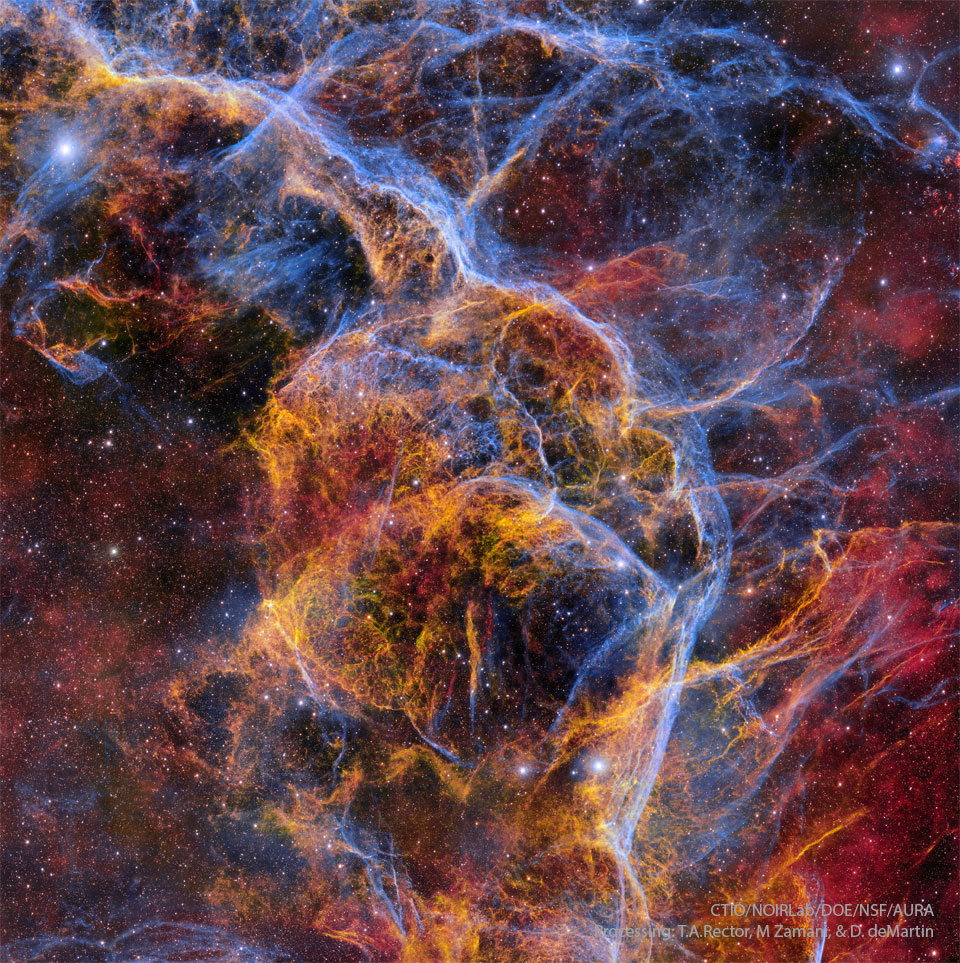
Most of the stars in the universe will, like our Sun, live steadily for billions of years before ending in relative serenity. However, a select few will go out in a blaze of glory called a supernova, the explosion of an entire star. These cosmic blasts are among the most powerful events in the universe, and can be seen at distances of billions of light years; releasing, in a matter of seconds, an amount of energy equal to the Sun’s output over billions of years. In the past few decades, observations of distant supernovas helped astronomers pin down the expansion rate of the universe, allowing the determination that the universe is not, as was previously expected, slowing down in its expansion, but speeding up, due to the presence of a mysterious force known as “dark energy.”

Nearly all of the matter in the universe that we understand is made of hydrogen and helium, the simplest elements, created in the Big Bang. The rest, including the oxygen that we breath, the carbon, calcium, and iron in our bodies, sodium and choride on our dinner tables, and the silicon in our computer chips were forged in the cores of stars: hot and powerful element factories that convert lighter elements into heavier ones. The gravity that holds stars together generally keeps these elements locked deep inside their interiors, never to be spread throughout the universe. Luckily, supernova explosions provide a mechanism to do just this, liberating these fundamental building blocks of planetary systems and, indeed, life itself, throughout the universe. It is no exaggeration to say that we owe our entire existence to the life, and death, of stars that existed before our Sun and solar system were even created.

In my research at NASA’s Goddard Space Flight Center, the fading of a supernova from view marks only the beginning of my interests. I study the fiery aftermath of the explosion, which remains visible for thousands of years. An exploding star doesn’t simply dissipate into nothingness; rather, it forms a nebula known as a supernova remnant, a cloud of gas expanding at speeds of several million miles per hour. The gas cloud is made up of both material that has been ejected from the now exploded star and particles of gas and dust tenuously floating in the interstellar medium, the scientific name for the space between the stars. An example of a supernova remnant is shown below. This remnant, the remains of a star that exploded in 1604 A.D, is known as Kepler’s SNR, named for the famous German astronomer who kept detailed records of “De Stella Nova” (the New Star).


Kepler’s Supernova remnant
Kepler’s Supernova remnant, as seen by NASA’s Spitzer Space Telescope (red), Hubble Space Telescope (yellow), and Chandra X-ray Observatory (green and blue). Credit: NASA, R. Sankrit (NASA Ames) and W.P. Blair (Johns Hopkins Univ.)

Read more »

[Blog] Awesomeness Round-Up – 1/31/2012

This is a doozy of a round-up, thanks to the American Astronomical Society meeting mid-month! Maggie already blogged about some of the interesting exoplanet news that came out at the meeting. Here, we’ll cover some of the other big astrophysics releases at AAS! But first… a gorgeous image from the European Southern Observatory.

The smoky pink core of the Omega Nebula
Credit: ESO

This image of the Omega Nebula (M17 or NGC 6618) was captured by the ESO’s ground-based Very Large Telescope (VLT). The nebula contains glowing hydrogen gas and filaments of dust, the very materials needed to create the the blue-white baby stars forming in this very active stellar nursery. You can read more about the nebula and this image in the ESO press release.

Read more »

[Blog] Awesomeness Round-Up – 12/22/2011

Hubble Holiday Card
Credit: NASA/ESA/HubbleSite

Looking for a space-themed way to say “Happy Holidays!” to your family and friends? How about some printable holiday cards with Hubble images? Every card features fabulous astronomical objects… and when you go to download a card, you’ll find links to articles about related Hubble discoveries! The ornaments above feature Mars, the Whirlpool Galaxy, the star LL Ori, and several nebulae – the Cone Nebula, the Orion Nebula, the Retina Nebula, the Eskimo Nebula, the Bubble Nebula, and the Crab Nebula. Can you tell which is which?
Read more »

[Blog] Awesomeness Round-Up – 12/7/2011

Closer to Finding an Earth
Credit: NASA/Ames/JPL-Caltech

While scientists have discovered hundreds of extrasolar planets over the past decade, finding Earth’s twin (an Earth-like planet in a similar orbit to ours around a Sun-like star) has been much more difficult. But a recent discovery by the Kepler mission has brought us one step closer – planet Kepler-22b is 2.4 times the radius of Earth, orbiting within the habitable zone (the region where an Earth-like planet could maintain liquid water on its surface) around a host star slightly smaller and cooler than our Sun. Kepler’s observations have identified several dozen other habitable zone planet candidates, and the mission will continue watching these objects as they transit in front of their host stars to see if more potential Earth twins are found.

Kepler-22b -- Comfortably Circling within the Habitable Zone
Credit: NASA/Ames/JPL-Caltech

Read more »

[Blog] Awesomeness Round-Up – 10/31/2011

Sara’s note: Don’t forget to enter our costume contest! You’ve still got a few more days to snap a pic of your geeky, science-y costume… and win NASA goodies! More details at the link above.

Aurora 6 med
Credit: David St. Louis

It’s been a busy couple of weeks in astronomy – big discoveries, the launch of NPP – but the biggest story about space may have been the huge geomagnetic storm on October 24th and the subsequent aurora seen all over the place! There are tons of photos that people have posted of the northern lights seen in their area. The coronal mass ejection that caused the event was powerful enough that aurora were seen at far lower latitudes than they are usually visible. Want to know more about the science behind the northern lights? Discovery News put together a nice feature about what causes aurora and what made this particular night’s so spectacular.
Read more »

[Blog] Awesomeness Round-Up – 8/29/2011

It’s been a rough week for the Mid-Atlantic region with the 1-2 punch of an earthquake and a hurricane rattling our region. Goddard got a good shake last Tuesday when a 5.8 magnitude earthquake prompted the center to close for the day. And over the weekend Hurricane Irene passed nearby, causing heavy rain and wind in the area. While both events were unusual for the area, Goddard doesn’t seem to have suffered any major damage. Below is a satellite image of the area showing where the Earthquake occurred and some staggering images and videos of Hurricane Irene’s enormous structure taken from the International Space Station as it passed overhead.

Hurricane Irene Reaches New York City
Hurricane Irene reaches New York City, Credit: NASA/NOAA GOES Project

Earthquake in Virginia
The earthquake was centered near Mineral, VA and was felt up and down the east coast, Credit: NASA Goddard/MODIS Rapid Response


Read more »

[Blog] Weekly Awesomeness Round-Up – 6/21/11

As Maggie mentioned in her intriguing post last week, things have been quite busy around here recently. So here is a bit of a catch-up edition of your weekly Awesomeness Round-Up. Enjoy!

Historically, astronomy has always required a great deal of patience as astronomers spent long, cold nights at the telescope, but that was only the beginning. NASA’s Chandra satellite exercised even more extreme measures of patience while it stared at a tiny patch of sky for more than six weeks in order to observe the incredibly faint galaxies visible in the Chandra Deep Field South (pictured below).  Chandra’s team announced last week that they had examined over 200 distant galaxies as they were approximately 800 to 950 million years after the Big Bang, finding that black holes were far more common in the early Universe than was ever previously suspected. These baby black holes will have continued to evolve into today’s supermassive black holes over the Universe’s 13 billion year lifetime.

Chandra Deep Field South (NASA, Chandra, Hubble, 06/15/11)
Credit: X-ray: NASA/CXC/U.Hawaii/E.Treister et al; Infrared: NASA/STScI/UC Santa Cruz/
G.Illingworth et al; Optical: NASA/STScI/S.Beckwith et al

Read more »

[Blog] Weekly Awesomeness Round-up – 3/7/11

Bald Eagle perched at NASA Goddard Space Flight Center

Credit: NASA/GSFC/Bill Hrybyk

Meet “Harry,” a bald eagle recently spotted here at NASA Goddard! Geeked on Goddard has a few more photos, as well as some information about bald eagles in Maryland. While we’re usually talking about the space exploration and research going on here, it’s also worth mentioning that Goddard covers over a thousand acres of land, much of it in a natural state. We’ve got lots of wooded areas and a lake, plenty of space for all of the geese and deer (and, apparently, bald eagles!) that live here. Though we’re just a handful of miles from Washington, DC, it can be pretty peaceful to walk through the woods at Goddard.

Read more »

[Koji's blog] Even Spherical Cows Have Udders

In astrophysics, we often use the term “standard candle.” It is a highly useful, yet also very dangerous, term.

The danger is that outsiders – the press, the general public, and even some scientists who are not intimately familiar with this particular subject – see this term and take it too literally. As an analogy, take the spherical cow, which has become a symbol of simplifying assumptions. Such assumptions make back-of-the envelope calculations possible. But a “spherical” cow is an approximation – if someone forgets this and says “since cows are spherical, they can’t have features like udders,” you would laugh him off. In less extreme and more common cases, people may forget to check the difference between the volume of a spherical cow and that of actual cows with a head, a tail, four legs, and udders. Some other people may ignore the fact that the volume of a real cow is not a unique function of its height. I have noticed a similar type of sloppiness regarding “standard” candles.

A cow [15/365]
Image Credit: Dave Wild (publicenergy)

Read more »

[Blog] Weekly Awesomeness Round-up – 1/31/11

Snowstorm blankets NASA Goddard
Credit: NASA/GSFC/Debbie Mccallum

I know that I kicked off last week’s round-up with a snow picture, but look! We got another six inches! Here’s the real NASA connection, though… imagery of the storm from the MODIS instrument, aboard the Terra satellite.

Satellite Image of January 27th Snowstorm
Credit: NASA Goddard/MODIS Rapid Response Team

Read more »

WordPress Themes